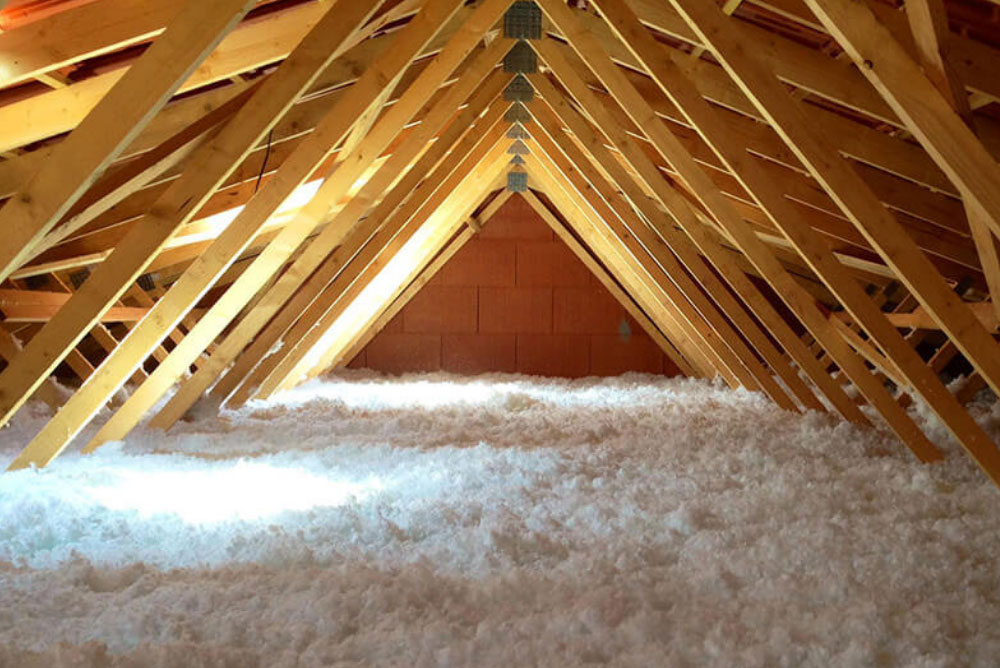
An attic is defined as the space present between the ceiling and the roof. By installing insulation in this space, the goal is to prevent heat, cold, and humidity from migrating between the roof and the habitable spaces of the building.
The attic can take several physical forms depending on the type of roof and the ceiling configuration:
- Sloped roof with an easy-to-access attic
- Sloped roof with a cramped and difficult-to-access attic
- Flat roof with an easy-to-access attic
- Flat roof with an inaccessible attic
- Cathedral ceiling following the slope of the roof
- Finished and heated attic
Some buildings may have several types of roofs, each requiring an adapted insulation strategy.
Insulating the attic, a generally simple and very profitable project
In a roof insulation project, the characteristics of the attic must be considered first because major technical constraints could limit the choice of appropriate insulation.
For example, easy-to-access attics are generally among the most profitable projects that can be carried out in insulation, both from the point of view of comfort and the savings generated.
At the other extreme, inaccessible or difficult-to-access attics, as well as cathedral ceilings, are projects that should ideally combine insulation with other work, such as during interior renovations or roof repair.
However, before entrusting insulation work to a general contractor or a roofing company, one must be aware that they do not necessarily have the required knowledge or access to the same insulation and equipment as a specialized insulation contractor. They risk being less efficient and less attentive to the details that make a difference in the building envelope. Finally, the prices asked are often much higher than those offered by a specialized contractor.
The attic, a place of extremes
Did you know that in the greater Quebec region, the temperature of an attic can vary between -35 and +60 Celsius during the same year? The relative humidity, for its part, will vary between 10% (desert conditions) and 100%!
With such significant differences, the role of insulation and airtightness is central to maintaining occupant comfort. Moreover, all these variations eventually reflect on heating and cooling costs in case of insufficiency or deficiency in the building envelope at this location.
Ideally, habitable spaces should be completely protected from the variations experienced in the attic, and the attic should be maintained at the same temperature as the outside air. Unfortunately, the reality is quite different. Except for buildings planned and built with the greatest care, interior spaces and the attic influence each other. The objective is therefore to minimize this interaction while preserving the integrity of the building.
Source: insulation-airplus.com