DecontaminationOctober 28, 2026
Vermiculite Testing: Find Out If It Contains Asbestos
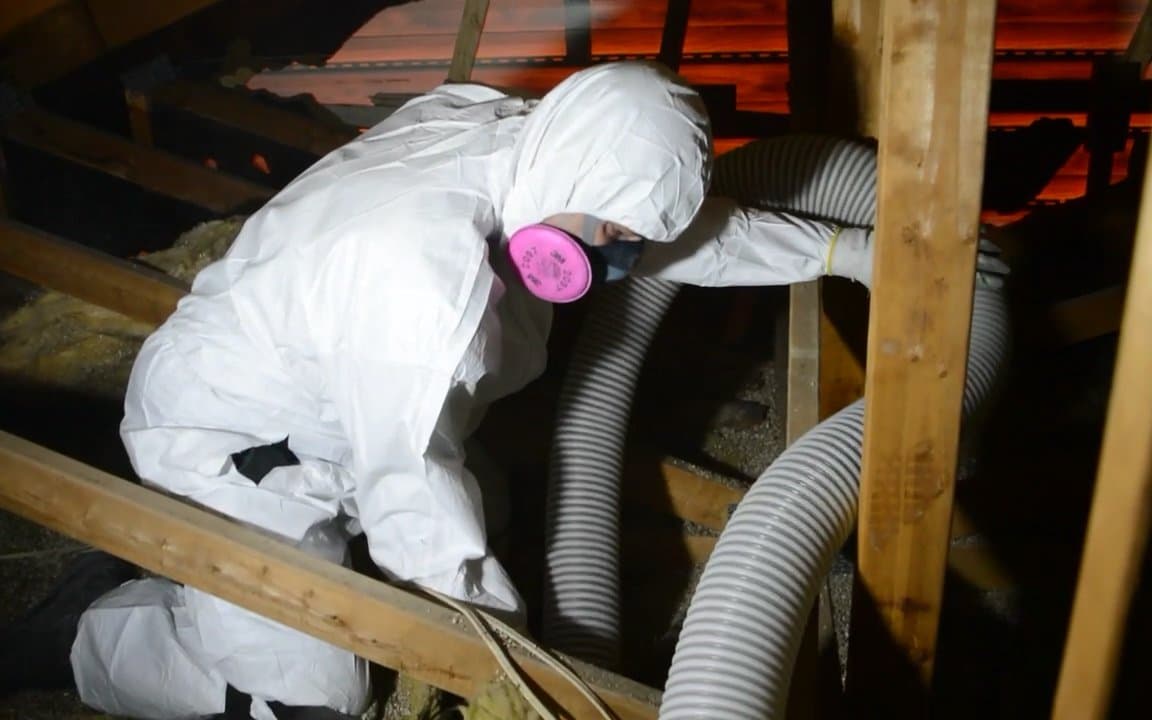
Vermiculite has a bad reputation, and for good reason: some of the vermiculite used as insulation in attics may contain asbestos. From there, it is only a short step to concluding that all vermiculite is dangerous, a step many homeowners take out of caution. The reality is more nuanced.
Whether the vermiculite in your attic actually contains asbestos cannot be guessed by eye: it is confirmed by a test. Understanding why this test is the only certainty, and what it involves, helps you make the right decision without panicking or downplaying the issue.
Should you have your vermiculite tested? The short version
Vermiculite does not always contain asbestos, but it is impossible to know simply by looking at it. The only reliable way to settle the question is to have a sample analyzed in a laboratory. While waiting for the result, the right approach is not to disturb it. If the test confirms the presence of asbestos, the removal of the vermiculite must be entrusted to professionals, such as the Solution Isolation team.
In other words, you don't guess: you get it tested, then act on the result.
Does vermiculite always contain asbestos?
No, not systematically. Some of the vermiculite used for insulation came from deposits that were contaminated with asbestos, but that is not the case for all vermiculite. The problem is that nothing visually distinguishes contaminated vermiculite from vermiculite that is not: same appearance, same granules.
It is this impossibility of telling them apart by eye that explains the rule of caution: until a test has confirmed otherwise, insulation vermiculite is treated as though it could contain asbestos. The basics of the subject are covered in the article Vermiculite and asbestos: what every homeowner should know; here, we focus on the step that removes the doubt, the test.
Why a test is the only certainty
Asbestos, when present, is mixed into vermiculite in the form of microscopic fibres. They are invisible to the naked eye and give off no odour, which makes any visual assessment unreliable. You can suspect their presence from the context, such as the age of the house, but you cannot confirm it without analysis.
A laboratory test examines a sample and determines whether it contains asbestos, and in what proportion. It is this data, and this alone, that lets you decide what comes next with full knowledge of the facts rather than by gut feeling.
How a vermiculite test works
The principle is simple, but it requires precautions. A sample of vermiculite is carefully collected, so as not to disperse fibres into the air, then sent to an accredited laboratory that carries out the analysis. The result indicates the presence or absence of asbestos.
The sensitive part is the sampling itself: stirring up vermiculite without precautions can release fibres, which defeats the purpose. That is why health authorities, including Health Canada and the CNESST, recommend against handling a suspected material yourself and advise going through professionals. Better a properly collected sample than an attic needlessly disturbed.
Depending on the result: two scenarios
Once you have the test in hand, two paths open up.
If the test is positive, the vermiculite contains asbestos and its removal must be carried out by a qualified team, with the appropriate equipment and methods. This is precisely the scope of attic decontamination: removing the material safely, without contaminating the rest of the house.
If the test is negative, the asbestos risk is ruled out. The vermiculite can then be managed more simply, even though it remains an outdated insulation that people often choose to replace for better performance. In both cases, the decision rests on reliable data, not on a guess.
And what about insulation?
Removing vermiculite rarely leaves an attic ready to face winter. Once the material has been safely taken out, the attic is often left under-insulated, which makes it the ideal time to install modern insulation, better suited to the Quebec climate.
That is the advantage of entrusting the whole job to a single team: the removal and the insulation upgrade follow one another, without having to coordinate several contractors. You settle a safety question while improving the comfort of the home.
Doubts about the vermiculite in your attic? Get clarity
Between panic and carelessness, there is a simple path: get it tested. A laboratory result replaces guesswork with certainty and points to the right decision, whether it is a safe removal or a simple insulation upgrade.
If your attic contains vermiculite, do not handle it and talk to specialists. Request a free quote from Solution Isolation. Serving the South Shore, Quebec City, Gatineau and all across Quebec, the team supports you from the removal of the vermiculite all the way to the new insulation of your attic.